
What is Muscle Memory? A Detailed Guide

Muscle memory is an essential factor that plays a critical role in both athletic training and rehabilitation. Many effective supplements are available online that help you maintain your muscle memory, such as Anavar, Testosterone Cypionate, Dianabol, etc. These boost your muscle memory and also improve recovery.
Muscle memory refers to the process by which our muscles perform repetitive tasks. If you want to improve motor skills, this phenomenon plays a critical role.
This also helps athletes and fitness enthusiasts who want to refine their techniques and perform tasks with efficiency. It's essential to understand that muscle memory is for optimising training routines, recovering from injuries, and mastering new skills. In this blog, we’ll explore a detailed overview of muscle memory.
What is Muscle Memory?
Muscle memory is our muscles' ability to do specific activities more efficiently with repetition. Motor learning happens when a person learns a new ability, such as how to tie their shoes or perform a push-up. Muscle memory, contrary to popular belief, is based on neuronal circuitry in the brain rather than the muscles.
When we practice a movement multiple times, our brain encodes the information, forming neural pathways between the central nervous system and muscle cells that make the action easier to do over time. This process involves both neurological and physiological changes, resulting in motions that are more automatic and need less conscious effort. Muscle memory is essential for a variety of activities, from simple ones like typing to complicated sports feats, and it plays an essential role in both training and recuperation.
Types of Muscle Memory
There are different types of muscle memory.
Procedural memory
Procedural memory helps acquire specialised motor abilities, such as how to play a musical instrument, perform intricate dance moves, or even practice a sport. This memory is retained in the brain, which allows you to perform learnt movements without thinking.
Strength memory
Strength memory is the ability of muscles to recall their former strength following a break in training or a brief cessation. For example, following an accident, some people may struggle to regain their initial strength. Still, with time and training, muscle memory allows them to regain their strength more quickly than during the first session.
Muscle adaptations:
In addition to changes in the brain and nervous system, repeated movements or exercises cause muscle adaptations. These adaptations include novel muscle fibre recruitment, neuromuscular link strengthening, and muscle development (hypertrophy). All of these changes lead to the formation of muscle memory.

How Does Muscle Memory Work?
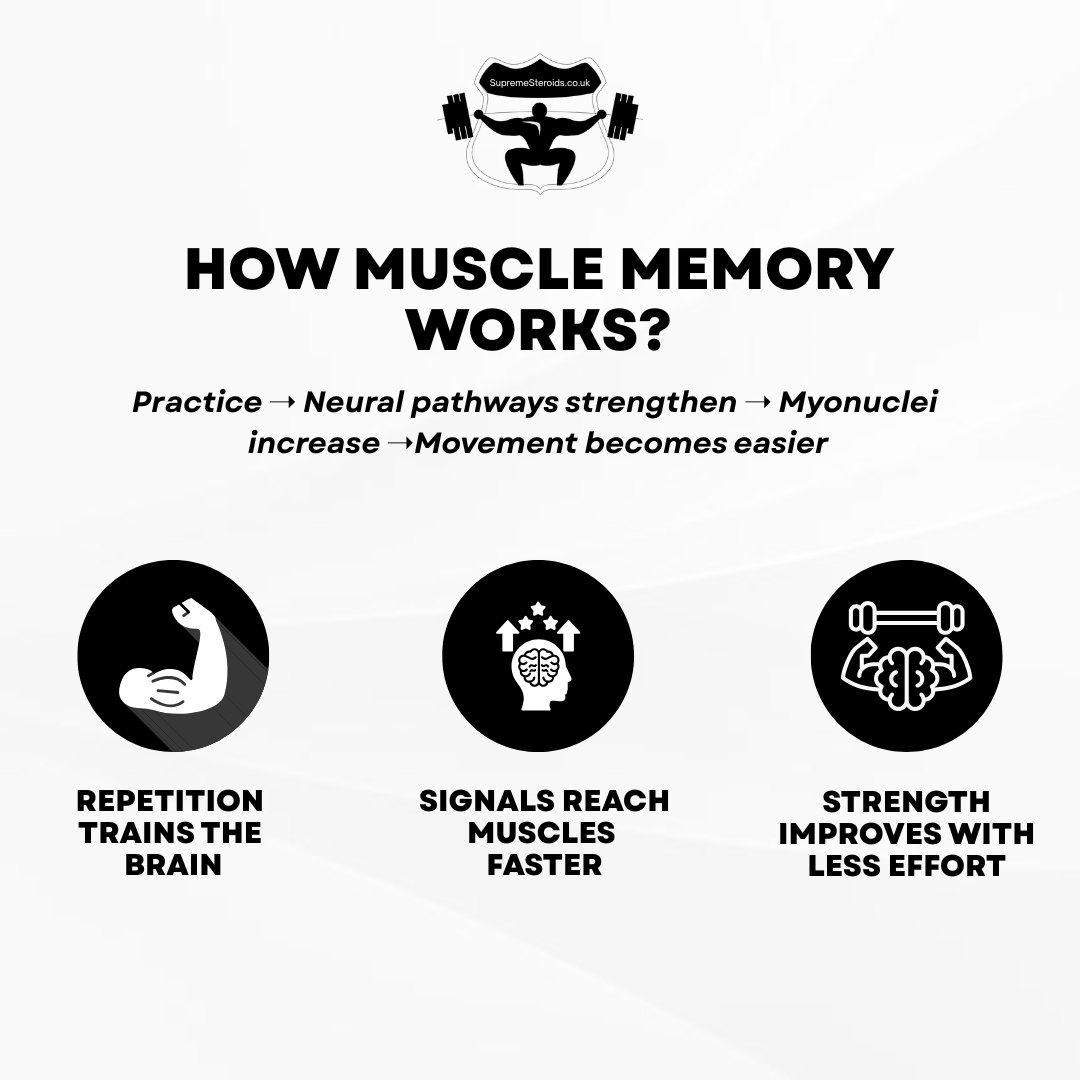
The muscle memory works when our brain and skeletal muscles collaborate to develop actions that eventually become automatic. You train your muscles to perform a task. Because your muscles cannot retain memories like the brain, they increase the number of muscle fibre nuclei (myonuclei) within trained muscle cells.
Consider these individuals to be members of a boat crew. The more crew members rowing the boat, the better it will perform during a race. Your muscle mass increases as the number of myonuclei increases. This helps you increase strength, allowing you to do the work with ease.
Benefits of Forming Muscles Memory
The most crucial benefit of forming muscle memory is that it may help you get back in shape quickly. Regular resistance exercise may trigger lasting cellular changes in your muscles. These changes can make it easier for your muscles to respond to training even after long periods of inactivity.
Adults completed a 7-week strength-training program. The program altered genes in muscle cells and helped participants build muscle. Then, they stopped training for 7 weeks, which made them lose the muscle they had gained. But the cellular changes remained. And when participants began retraining for another 7 weeks, they were able to gain muscle faster than before.
That's good news for anyone who has to take a break from their fitness routine due to injury, illness, or other reasons. It may only take 2 weeks of inactivity to undo progress like increasing muscle strength. So getting back on track quickly is helpful.
Limitations of Muscle Memory
For some time, it was hypothesised that the increase in myonuclei in humans might be long-lasting or even permanent. At this time, the length of time that muscle memory lasts is uncertain. A review of research on muscle memory from Snijders et al. (2020) found that “there is no consensus within the scientific community on the existence of muscle memory by myonuclear permanence in human skeletal muscle, and more research is warranted using properly designed intervention studies.”
Further research is needed to form a more conclusive consensus on the lifespan of myonuclei that are gained through training and the implications of muscle re-growth.
It’s important to note that muscle memory is NOT the ability of the muscles to remember movements. The term muscle memory can be a bit of a misnomer because muscles don’t technically remember anything. In the brain, information is encoded, stored, and retrieved. What we perceive as the muscles “remembering” refers to motor learning that occurs in the central nervous system (CNS), not the muscles.
If you’ve ever taken years off from riding a bike, you may be surprised that after just a few wobbly moments, you’re riding as if you never took time off. Your brain remembers how to ride the bike, and you remain upright.
There is a neural component to muscle memory since someone who has performed an exercise before will do so more efficiently than someone who has not, which may aid efforts to gain muscle mass.
Supplements For Improving Muscle Memory
Several medicines are used to improve muscle memory and faster recovery. You can easily buy these pills at Supreme Steroids.
FAQs About Muscle Memory
How long does muscle memory last?
The results vary person to person, so it is not confirm how much time it takes to show their results. But according to research, the muscle memory after resistance exercise may last 12 to 22 weeks.
Does everyone have muscle memory?
Yes, everyone has the capacity to build muscle memory. But every person's capacity and power are different.
Where is muscle memory stored?
Muscle memory is stored in your brain, not in your muscles. Long-term memories form in your hippocampus (in your temporal lobe).
Where Can I Buy Supplements for Muscle Memory?
At Supreme Steroids, you can buy verified and tested supplements for muscle growth.
Conclusion
Muscle memory is essential to help your body perform and adapt to different types of physical activities. It’s essential to understand how it works and understanding how it works and how to use it can significantly improve your athletic performance. Many supplements are also available to boost your muscle memory and improve athletic performance.
Dr. Aditya K. Sharma
I am a urologist with extensive experience in kidney transplants and urological surgery. I specialise in treating patients with kidney and urinary complications and in providing careful, evidence-based guidance. I have in-depth knowledge about the effects of anabolic steroids on the body, especially in bodybuilding. I help people understand the impacts of steroids and guide them in making informed decisions.
View all posts by Dr. Aditya K. Sharma